
Baby bath towel supplier for poncho, hooded and muslin bath ranges
A baby bath towel range is decided by the moment it serves: a wearable baby poncho towel for the stand-and-dry stage, a hooded baby towel wrap for the newborn bath, and flat muslin towels for the rest of the day. We supply all three in cotton muslin and knitted cotton, as wholesale baby bath towels under your own brand, with the artwork shared across your swaddle and bib lines.
What the styles look like
Pieces from the current range, photographed as examples. Prints, colourways and packaging shown are samples of what we run — your own artwork is applied at the sampling stage.
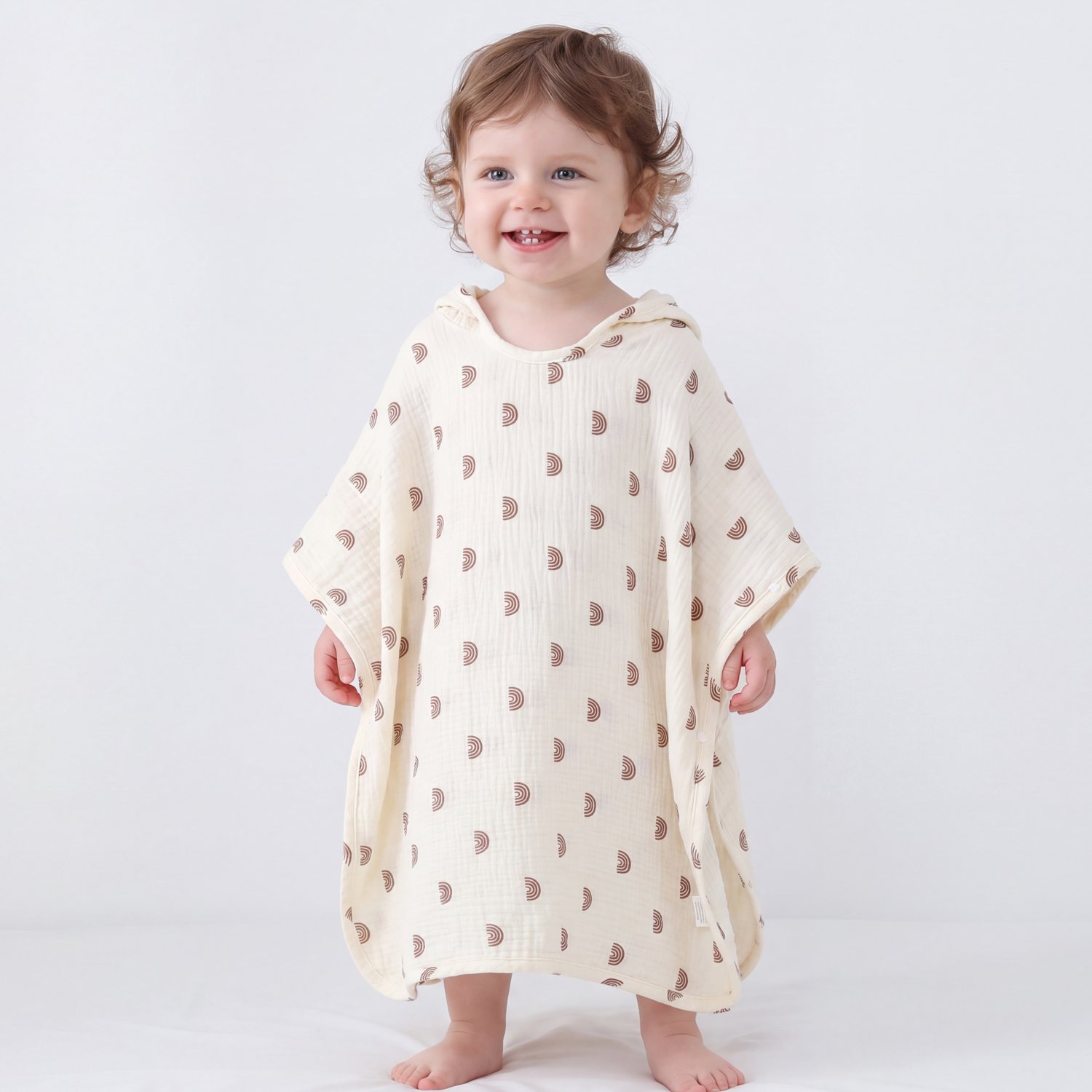
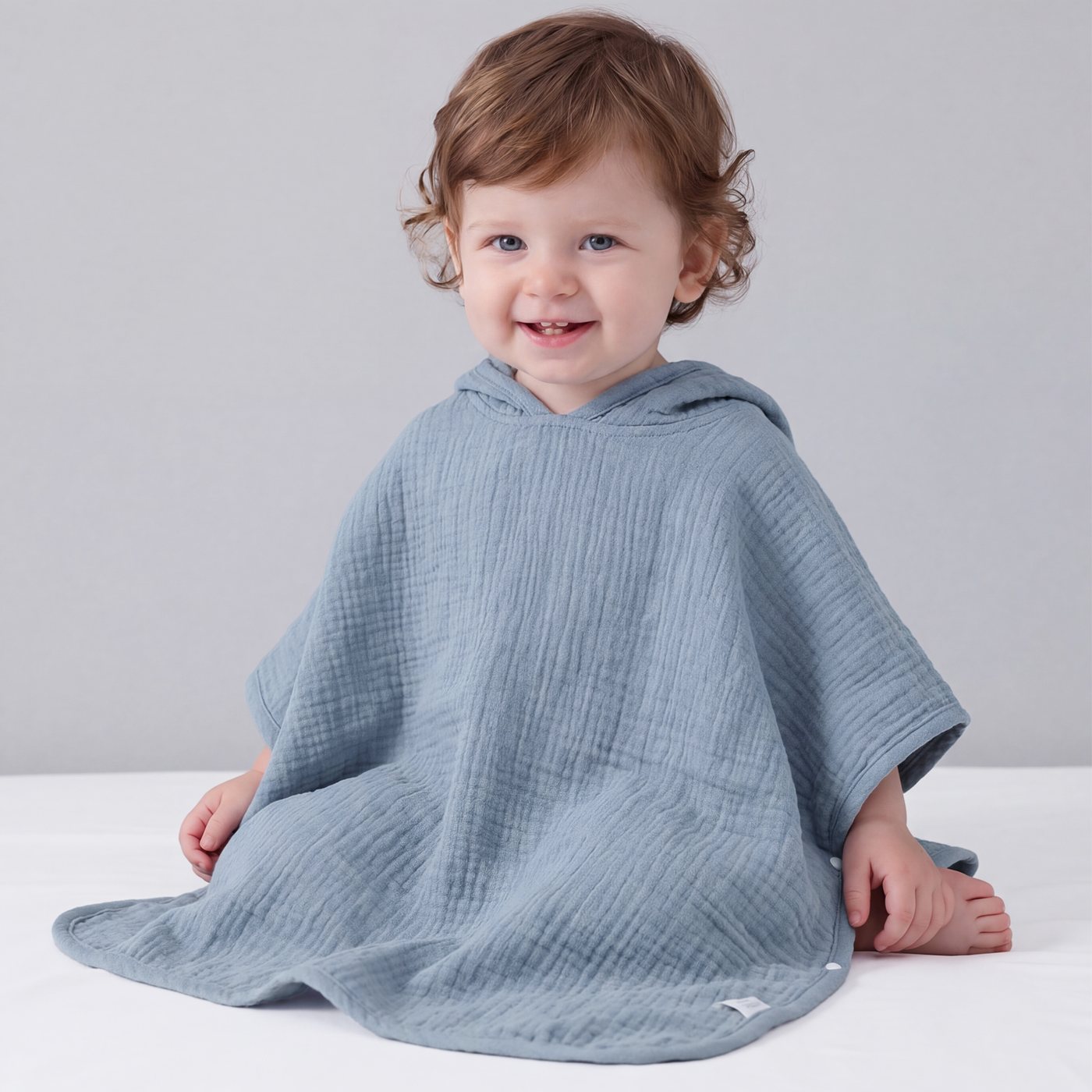
Four cloths, four different dry times
The cloth decides how the towel behaves after the bath, and it decides the care wording. Weight is quoted per fabric in gsm, with a tolerance band, once the fabric is chosen.
| Cloth | Construction | How it behaves | Where it fits |
|---|---|---|---|
| Cotton muslin, 2 ply | Open-weave double gauze | Driest fastest and packs thinnest of the four | Summer and travel ranges, 0 to 12 months |
| Cotton muslin, 4 ply | Four-layer gauze, brushed or plain | Absorbs more per pass, still quick to line dry | The everyday poncho and wrap |
| Cotton muslin, 6 ply | Six-layer gauze, bound edge | The most absorbent muslin build, the slowest of the three to dry | Newborn bath and gifting sets |
| Knitted cotton | Single jersey knit, 1 layer with a bound hood | Softest hand-feel, warmest against the skin, heavier in the bag | Autumn and winter ponchos, 12 to 36 months |
Layer count is what a buyer should compare between quotes, not the fibre name alone: a 2-ply and a 6-ply muslin towel are both “cotton muslin” and are not the same product. Each build is sampled and washed 3 times before the absorbency target is set.
The towel that stays on sells the range
A wet baby will not wait. Wearable towels win at retail because they solve the hand-over-hand drying problem, and they are the piece that photographs for your listing.
| Style | Construction | Where it sells |
|---|---|---|
| Baby poncho towel | A wearable hooded towel that slips over the head and leaves both hands free, cut in cotton muslin or knitted cotton | The hero piece of a bath line; one style runs across prints and colourways |
| Hooded bath wrap | A flat bath wrap with a sewn-in hood for swaddling a baby dry after the bath | The classic gifting shape; usually sold in 2-packs |
| Knitted cotton poncho | A heavier knitted-cotton poncho towel with a bound hood edge | Autumn and winter ranges where a warmer hand-feel sells |
| Muslin bath towel | Flat six-layer cotton muslin bath towels that wash fast and pack light | Travel and everyday lines; shares fabric with the swaddle programme |
What to fix before sampling
| Point | Why it matters |
|---|---|
| Wearability | Head opening and armholes are checked against the smallest height band; a poncho that fights the head is returned at retail |
| Hood construction | A sewn-in hood keeps its shape after washing; a folded-corner hood is cheaper but loosens |
| Fabric and layers | Muslin layer count and knit weight decide dry time and hand-feel; both are sampled before the care label is written |
| Absorbency | Verified on the washed sample, after the care-label wash cycle |
| Binding and edge | Bound edges survive the wash cycle; overlocked edges are the first failure point |
| Packing | Poncho towels fold into a flat polybag or a printed band; gift sets pair a towel with a washcloth or a bib |
Bath towels carry no thermal rating to quote. The specification story is fabric, layers, hood construction and dry time — and the size set is decided by height band, not by age.
What is specified on the order, and what varies
Every line below appears on the specification you receive with the quote. The third column is the honest part: what changes from style to style, so you know which points to fix and which to leave open.
| Item | What we specify | Where it varies |
|---|---|---|
| Style | Wearable poncho towel, flat hooded bath wrap, knitted poncho, or a flat muslin bath towel | Per style; a poncho and a wrap are different patterns |
| Fibre | Cotton muslin (multi-layer), knitted cotton, or a stated blend | Per style; the blend is stated as percentages, not as a fibre name |
| Layers and weight | Muslin layer count or knit weight, quoted with a tolerance band | Per fabric; dry time and hand-feel follow from it |
| Hood construction | Sewn-in hood with a bound edge, or a folded-corner hood | Per style; a sewn-in hood holds its shape through washing |
| Head and arm opening | Finished opening measured against the smallest height band | Per size set; the opening is what decides whether the towel is wearable |
| Size band | Height-based for ponchos; length-based for flat wraps and towels | Per size set, quoted as points of measure |
| Edge finish | Bound edge, overlock, or a turned-and-stitched hem | Per fabric; the edge is the first failure point on a washed towel |
| Packing | Flat polybag, printed band, or a gift set with a washcloth | Per artwork; the band or box print run is usually the binding minimum |
| Labels | Woven or printed main label, care and composition label | Per artwork; wording checked against the destination market |
If your own tech pack uses different points of measure, send it. We work from your document and note where it differs from ours, rather than silently translating it.
What can carry your brand
Private label, custom print and custom development are three different jobs with three different minimums. The third column says which one you are actually buying into.
| Element | What we can do | What drives the minimum |
|---|---|---|
| Digital or rotary, all-over or placement, on the shell or the hood lining | Print minimum per artwork and per colourway | |
| Colour | Stock muslin or knit shade, or dyed to a colour standard | Dye lot minimum per colour |
| Hood | Sewn-in hood with a bound edge, or a contrast lining | Pattern work plus a sampling stage; a contrast lining is its own minimum |
| Hardware | None on a standard poncho; snaps only where the pattern uses them | Hardware lot minimum, plus a small-parts review |
| Labels | Woven or printed main label, care and composition label, size flag | Label run |
| Packaging | Flat polybag, printed band, or a gift set with a washcloth | Band or box print run, usually the binding constraint on a gifting set |
How the minimum is calculated
We do not publish one headline minimum, because a single number is always the easiest combination rather than yours. These are the rules the number comes from.
| Question | How it works |
|---|---|
| How the minimum is calculated | Largest of: fabric run, print minimum per artwork and colourway, style minimum per size, and the packing print run. |
| How colours and styles combine | Each artwork carries its own print minimum. Plain-colour towels mix more freely than printed ones, and a poncho and a wrap are separate style minimums. |
| Mixing within one order | Muslin bath towels share cloth with the swaddle and bib lines, so one fabric lot can cover a towel, a swaddle and a bib in the same print. |
| Repeat orders | A repeat on an approved sample and existing fabric carries a lower minimum; stated in the first quote. |
| Price breaks | Fabric, making, hood and binding, packing and testing are quoted as separate lines with quantity breaks. |
What you send, what comes back
Sampling is where a specification stops being a document. This is the sequence, and what each stage settles.
| Stage | What happens |
|---|---|
| What to send | A reference towel or photos, the style direction (poncho, wrap or flat), the size band, artwork if printed, and the destination market. |
| What we send back | A specification sheet with finished openings, length and width, hood construction and the absorbency test result. |
| What the sample settles | Wearability of the head opening, dry time after the care-label wash cycle, hood shape retention and edge integrity. |
| Cost and timing | Sample cost and stage timing stated in the quote; a knitted poncho adds a knit programme sample stage. |
| Sealed sample | Bulk follows the sealed sample for fabric, hood construction, binding and size set. |
Lead time is quoted per stage — sampling, material, bulk, shipping — rather than as one figure that hides where the waiting is. The same applies to sample cost: it is stated with any credit against bulk.
What a document covers, and what it does not
A test report is only useful if you know its boundary. The third column is the boundary, written the way we would explain it on a call.
| Document | Covers | Does not cover |
|---|---|---|
| In-house inspection record | Opening measurements, absorbency check, hood shape and edge integrity, per batch | Our own record, not a third-party report |
| Fibre composition statement | Shell and trim composition as labelled | A declaration, not a certification |
| Third-party test report | The standards named in the report, for the submitted style | Does not cover a changed fabric or binding |
| Wash-cycle record | Size and hand-feel after the care-label wash cycle, per fabric | Run on the sample fabric lot, not on every bulk lot |
How buyers build a bath line
Bath ranges are small and repeatable: one hero poncho, one or two wraps, and a washcloth set. The fabric decision comes first, because the same muslin programme can carry a swaddle, a towel and a bib in the same artwork.
| Stage | What the range carries | What drives the minimum |
|---|---|---|
| Newborn gift set | Hooded bath wrap in 2-packs, matched to a muslin swaddle | The fabric lot, shared with the swaddle programme |
| Toddler bath | Wearable poncho towels in prints and solids | Print minimum per artwork and colourway |
| Winter extension | Knitted-cotton poncho with a bound hood edge | Knit programme minimum, quoted per weight |
A bath line launched alongside swaddles usually reuses the artwork and the fabric lot, which is why it is one of the lowest-risk extensions of a sleep-sack programme. Gift sets are quoted as 2-, 3- and 4-piece bands: a poncho with a washcloth, a wrap with a swaddle, or a full bath set of 4.
The size set you quote on
Ponchos are graded by height, flat wraps by length. The set below is the working starting point we quote against; the final points of measure are confirmed on the sealed sample rather than assumed at quote stage.
| Piece | Working size band | Packed as |
|---|---|---|
| Poncho towel | One size, roughly 6 to 36 months, graded by height band rather than by age | Flat polybag, or banded in 2 |
| Hooded bath wrap | Two sizes, covering 0 to 12 months and 12 to 36 months | 2-pack with a printed band |
| Flat muslin bath towel | Two lengths, quoted as points of measure in cm with inches in brackets | 3-pack, band shared with the swaddle line |
| Knitted poncho | One size, 12 to 36 months | Folded flat, 1 per polybag |
Care wording follows the fabric: muslin is labelled for a 30 to 40°C wash and a low tumble, knitted cotton for a cooler wash and air drying. The care-label cycle is run on the sealed sample before the wording is printed, and the absorbency figure is taken after that cycle, not before it.
Questions buyers ask
Poncho towel or hooded wrap?
Which fabric should a bath line use?
How is absorbency checked?
What sizes does a bath towel range need?
Can bath towels share fabric with our swaddles?
Building a bath line?
Send the towel styles, the fabric decision and the artwork. We confirm the size set, hood construction and absorbency target before sampling.