
Footed vs footless baby sleepsuits for your collection
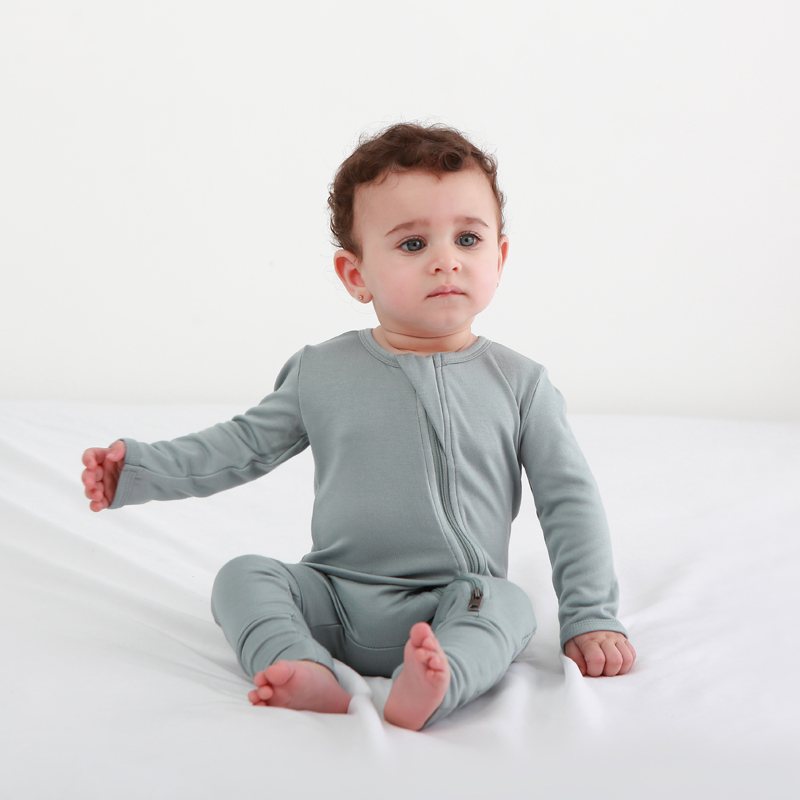
A footed sleepsuit encloses the foot and replaces socks; a footless sleepsuit ends at the ankle and is worn with socks or used in warmer rooms. The choice changes the pattern, the size grading, the closure layout and, in some markets, the test route. It is written for brands building sleepwear to sit alongside a sleep sack range.
Two names, two markets
The same garment is a footed pajama or sleeper in the United States and a sleepsuit or babygrow in the United Kingdom. Footless versions are sold as footless pajamas or pyjamas without feet. The garment is identical; the label copy and the search term are not, and both have to be right for the market you sell into.
Foot construction
| Type | What it is | Procurement note |
|---|---|---|
| Enclosed foot | Fabric continues into a closed foot | Foot length is a graded measurement; tolerance matters more than on any other point |
| Enclosed foot with cuff | Ribbed cuff at the ankle | Better fit retention; extra operation |
| Turn-back cuff | Long cuff that folds over the foot | Converts footed to footless; popular for grow room |
| Footless with cuff | Ends at the ankle | Simplest pattern, cheapest, most forgiving on grading |
The turn-back cuff is the compromise most brands land on, because it extends the usable life of the garment by a size band. It also adds fabric consumption and a seam that has to be flat enough not to press on the ankle.
Sizing and grow room
Sleepsuits are bought by height, not by age. Two babies of the same age can differ by two size bands, so a month label alone is not a fit specification. Quote the size set as height ranges with a points-of-measure chart: chest, body length, sleeve, inseam and foot length, each with a tolerance.
Grow room is a design decision with a cost. Longer body and longer sleeve extend wear but look oversized at retail and photograph badly on a small baby. The usual compromise is a modest allowance in body length plus a turn-back cuff, rather than a garment that is generous everywhere.
Closures
- Full-length zip — fastest at 3am, and the reason parents pay more.
- Two-way zip — nappy changes without undressing; a real cost line, not a free upgrade.
- Poppers — cheapest, most traditional, slowest in use.
- Zip plus poppers at the leg — a common hybrid; more operations, better access.
Whatever the closure, the zip guard at the neck and the attachment security of the puller are specified separately. A detachable puller is a small-parts hazard, and it is the kind of detail that decides whether a batch is saleable.
Season, fabric weight and layering
A sleepsuit is worn under a sleep sack, so the two have to be planned together. A heavy interlock sleepsuit under a 3.5 TOG sack is a different product from a light jersey sleepsuit under a 1.0 TOG sack, even though both look like a baby sleeping. State the room temperature the range is sold for, and the layer the sleepsuit is meant to be within.
Specifying the foot so it survives grading
Foot length is the measurement most likely to fail across a size set, because it has to track leg length rather than grow proportionally with chest. Two decisions make the difference: where the toe seam sits, and how much allowance the foot carries beyond the longest expected foot.
Put the seam on top of the toe rather than across the tip, and keep it flat-locked: a ridge at the toe is felt by every baby that kicks. Then state the foot length per size with a tolerance in the points-of-measure sheet — without a tolerance, the supplier chooses one and you find out at inspection.
For a turn-back cuff, add the cuff depth to the body length calculation. It is the most common source of a sleepsuit that measures correctly but does not fit.
Market requirements
Children’s sleepwear is regulated differently from daywear in several markets, and the route depends on the design, the fibre and the fit. In the United States, sleepwear requirements are not the same as those for ordinary children’s garments; in the UK and EU, the general product safety and labelling framework applies alongside fibre and care labelling.
We do not describe a style as compliant in general. We state which document covers which style in which market, and who issued it — and where a report does not exist yet, we say that rather than implying it does.
| Point (cm) | 0–3 m | 3–6 m | 6–9 m | Tolerance |
|---|---|---|---|---|
| Body length | 56 | 62 | 68 | ±1.0 |
| Sleeve | 24 | 26 | 28 | ±0.5 |
| Inseam | 18 | 20 | 22 | ±0.5 |
| Foot length | 9 | 10 | 11 | ±0.4 |
| Cuff depth (turn-back) | 5 | 5 | 5.5 | ±0.3 |
Foot length carries the tightest tolerance because it is the measurement most likely to fail across a size set. Illustrative values, not a stock product — they show the level of detail a spec sheet needs.
What we can put in front of you
Evidence for the points above, in the form a buyer can check rather than take on trust:
- Points of measure with tolerancePer size, including foot length and cuff depth — without a tolerance, the tolerance is chosen for you.
- Foot length, measured flatToe seam position recorded, because a ridge at the toe is felt by every baby that kicks.
- Puller attachment resultOn the actual puller and the actual fixing method, not on the zip brand’s literature.
From the question to a quote
- 1This guide — the decision behind the question, in the abstract.
- 2Baby clothes — the construction, fabric and size specifications it applies to.
- 3All product lines — if the programme spans more than one line in the same shipment.
- 4Request a quote or a sample — send the fabric, the size set and the expected quantity.
Sources and standards
- 16 CFR Part 1615 — Standard for the Flammability of Children’s Sleepwear, Sizes 0 Through 6X (eCFR)
- 16 CFR Part 1610 — Standard for the Flammability of Clothing Textiles (eCFR)
- US Federal Trade Commission — Threading Your Way Through the Labeling Requirements Under the Textile and Wool Acts (16 CFR Part 303)
Links go to the issuing body’s own publication. Where a rule differs by market, the market is named in the text above; nothing here is a statement that a specific product is certified.
Frequently asked questions
Are footed sleepsuits harder to grade?
Do grippy soles matter on baby sizes?
Does a sleepsuit need separate sleepwear testing?
Related
Send three things, get a real answer
Fabric or construction direction, the size set you are planning, and the quantity you expect for a first order. Approximate is fine — the point is to quote against your programme rather than against an average. If you already have a reference sample or a spec sheet, send that instead and we will work from it.