
Baby sleep sack MOQ explained
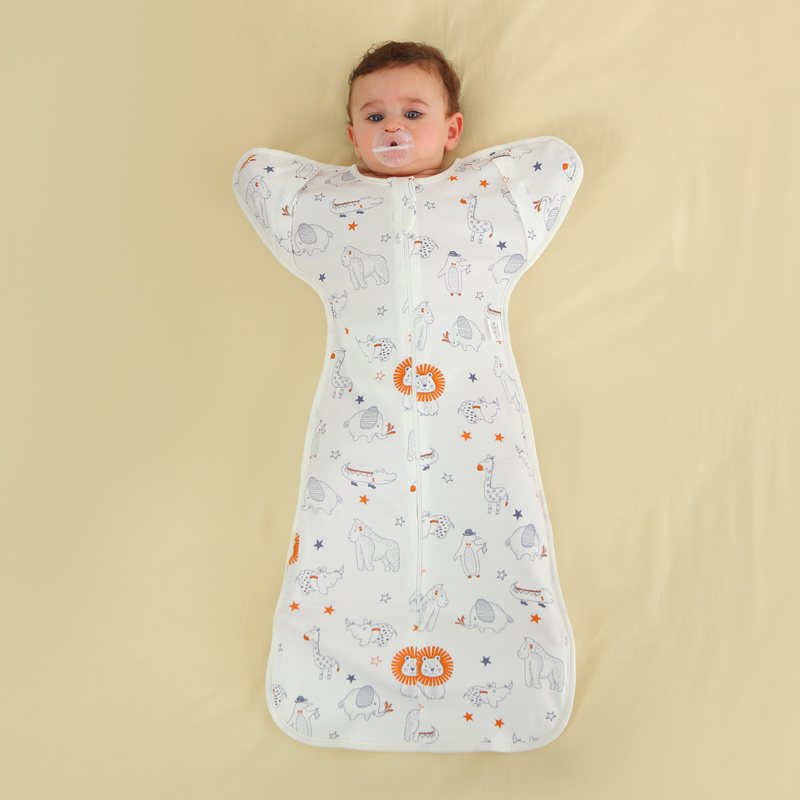
There is no single MOQ for custom baby sleep sacks. The order minimum is the largest of four separate minimums: the fabric minimum, the print or dye-lot minimum, the style minimum per size and colour, and the packaging print run. A supplier quoting one number is usually quoting the easiest combination, not yours.
The four minimums, and why they stack
A sleep sack is not one purchase. It is fabric, a print or dye operation, sewing, trims and packaging, and each of those has its own economic batch size. Asking “what is your MOQ” collapses four answers into one and produces a number that will not survive the first quote revision.
| Minimum | Driven by | How it behaves |
|---|---|---|
| Fabric | Mill run length for that quality | Falls if you choose a stock quality already running |
| Print / dye | Setup cost per colourway | Per colourway, not per order: six prints is six minimums |
| Style / size / colour | Cutting and line setup | Multiplies across the size set |
| Packaging | Print run for the box or band | Often the binding constraint on small, premium orders |
The practical consequence: a plain sleep sack in two sizes and one colour has a very different minimum from the same style in three prints across four sizes in a printed gift box. They are not the same product commercially even though the pattern is identical.
Why the size set multiplies everything
Each size is a separate cut and a separate line setup. Four sizes in two colours is eight style-and-colour combinations. If the style minimum is set per combination, the arithmetic is not “total units” but “total units divided by eight”, which is usually where a first-time buyer’s plan breaks.
The common fix is to launch a narrower size band — often 0–6 and 6–12 months — and extend once the first run has sold. It is a commercial decision, not a manufacturing limitation.
Questions that get you a real number
- Is this a stock fabric or does it need to be woven for us?
- Is the print minimum per design or per colourway within a design?
- Is the style minimum per size, or per style across the size set?
- Does the packaging have its own minimum, and is it binding here?
- What is the minimum for a repeat order, as opposed to a first order?
Repeat minimums matter more than first-order minimums. A supplier who will not tell you the repeat minimum before you place the first order is telling you something.
Five legitimate ways to lower a first minimum
Lowering a minimum is not a negotiation trick; it is usually a specification decision. These five work because they remove a setup rather than asking a supplier to lose money:
- Use a stock fabric. Removes the mill minimum entirely and shortens the critical path.
- Cut the number of colourways. Each colourway carries its own dye or print setup, so two instead of four is a direct reduction.
- Narrow the size band. Two sizes instead of four keeps the quantity per size above the style minimum.
- Launch plain, print later. A plain first run removes the print minimum and gives you real sales data before you commit artwork.
- Take stock packaging. A printed box on a first order is often the single binding constraint, and it is the easiest one to defer.
Each of these has a cost in positioning rather than in money: a narrower range, a later print, a plainer pack. That trade is usually worth making on a first order and worth reversing on the second.
Where buyers go wrong
The expensive mistake is not choosing a high minimum. It is choosing a low one on a construction the supplier cannot actually run at that volume, then discovering it at the sampling stage after the artwork has been prepared and the launch date has been announced.
Our approach is to give the four minimums separately, in writing, before sampling. That way the number you plan against is one you can argue with.
| Combination | Count | What it multiplies |
|---|---|---|
| Colours × sizes | 2 × 4 = 8 | The style minimum applies eight times |
| Prints | 1 | One print set-up, on top of the style minimum |
| Packaging | 1 | One print run, separately minimumed |
If the quoted style minimum is M, the order has to clear 8M before any other minimum is even considered. Drop to two sizes and one colour and the same units clear 2M — which is why narrowing the launch band is the most common fix. Put your own figure in for M: the arithmetic, not the number, is the point.
What we can put in front of you
Evidence for the points above, in the form a buyer can check rather than take on trust:
- Four minimums, in writingFabric, print or dye lot, style per size and colour, and packaging quoted as separate lines rather than one headline figure.
- Repeat minimumStated before the first order, not after. It is usually the number that decides whether a programme is worth starting.
- Stock versus made-for-youWhich qualities are already running, because a stock quality removes the mill minimum entirely.
From the question to a quote
- 1This guide — the decision behind the question, in the abstract.
- 2Baby sleep sacks — the construction, fabric and size specifications it applies to.
- 3All product lines — if the programme spans more than one line in the same shipment.
- 4Request a quote or a sample — send the fabric, the size set and the expected quantity.
Frequently asked questions
What is a typical MOQ for baby sleep sacks?
Can I order a sample before committing to a minimum?
Is the minimum lower for plain styles?
Related
- Baby sleep sacks: constructions and TOG
- Private label: six stages and deliverables
- Muslin vs jersey swaddles
Send three things, get a real answer
Fabric or construction direction, the size set you are planning, and the quantity you expect for a first order. Approximate is fine — the point is to quote against your programme rather than against an average. If you already have a reference sample or a spec sheet, send that instead and we will work from it.